
Why the Right to Repair Movement is Reshaping the Automotive Parts Industry
Originally, the Right to Repair was a battle over the control of the repair manual for your car. However, that has escalated to a more significant issue: a complete transformation of the entire process of parts distribution. This transformation involves gaining access to data and making better choices behind the scenes so that recycled parts are no longer at the bottom of the list but become the most popular option.
The dealer-only parts monopoly is cracking
For decades, the after-sales side of the car industry was possible because OEMs could build scarcity into the aftermarket. They had control over proprietary diagnostic systems, repair & maintenance information and part sales, used restricted distribution channels (like making the dealership the only realistic source for parts), and could determine the price. Independent repair shops could still turn a wrench, but they were often locked out of the software and data needed to do it properly. This created a market where other suppliers (the people who fix vehicles) compete for parts that the OEM sells at a price that gives it a margin but doesn’t undercut the dealers’ repair operation.
In the US, the relative success of Right to Repair legislation means Massachusetts’ 2020 ballot measure is about to give owners and the independent repair market access to the tools that were previously reserved for the dealer network. In the EU, these directives are also pushing the availability of repair information. This sounds small enough but it has significant implications. It means a mechanic down the road can now get the same diagnostic read as a dealership, and a parts supplier can compete on a level field instead of being frozen out by design.
When repair costs more than the car is worth
An aspect that we don’t pay enough attention to is that overpriced dealer-only parts not only upset owners but also drive functional vehicles to the junkyard. When the cost of repair is greater than the car’s value, insurers and owners total them, even though the rest of the vehicle might be perfectly fine. No user or owner should ever be compelled to scrap a vehicle because a hail storm dented its hood, but under manufacturer-sanctioned monopoly pricing, many are.
The double carbon cost nobody talks about
The environmental cost of each premature write-off may not be immediately obvious, but it’s real. Roughly 20% of a petrol car’s lifetime emissions come from manufacturing, a figure that rises to about 70% for an electric car charged with abundant, low-emission renewables. So when a repairable vehicle gets scrapped early, you’re paying twice – you lose the embodied energy already sunk into the vehicle sitting in the driveway, and then you trigger the full manufacturing footprint of whatever replaces it. Every extra year a car stays on the road without needing a new one built from scratch is a real emissions saving, not a marketing line.
Smarter parts matching is the practical fix
The real nuts and bolts of this system are far less captivating than the political press releases but far more effective in practice. Smart parts matching essentially turns a vehicle’s VIN and the OEM part numbers coded to that VIN into a shortcut to identify exactly which components will be a perfect fit regardless of model year, trim, or engine variation. This information is used to cross-reference a massive database of parts and assemblies without guessing based on make and model alone.
A VIN stores way more data than people tend to realize – engine type, transmission, specific options, sometimes even the factory that put it together. An OEM part number is far more specific than the string of characters it often appears to be, indicating exact build specifications that often vary part by part over a given model’s production run. Matching a VIN with a part number from that vehicle gives a parts supplier what they need to confirm the fit, one dealer-level spec check later.
Whether that check is run on a brand new component or a used one doesn’t make a difference. A working transmission from another vehicle, a door panel that never made it into a build, an engine kept in storage since that model was discontinued – these are functionally, structurally the same as a dealer ordered part. The cost savings for this kind of part are massive. But compatibility is only half the job. A reputable operation grades condition too, separating cosmetic components from safety-critical ones and testing accordingly. A used trim panel with minor wear is a different proposition from a used steering component, and treating them the same is how the recycled parts industry got a bad reputation in the first place. The operators doing this well warrant what they sell, because they’ve actually verified it.
Modern wreckers aren’t scrapyards anymore
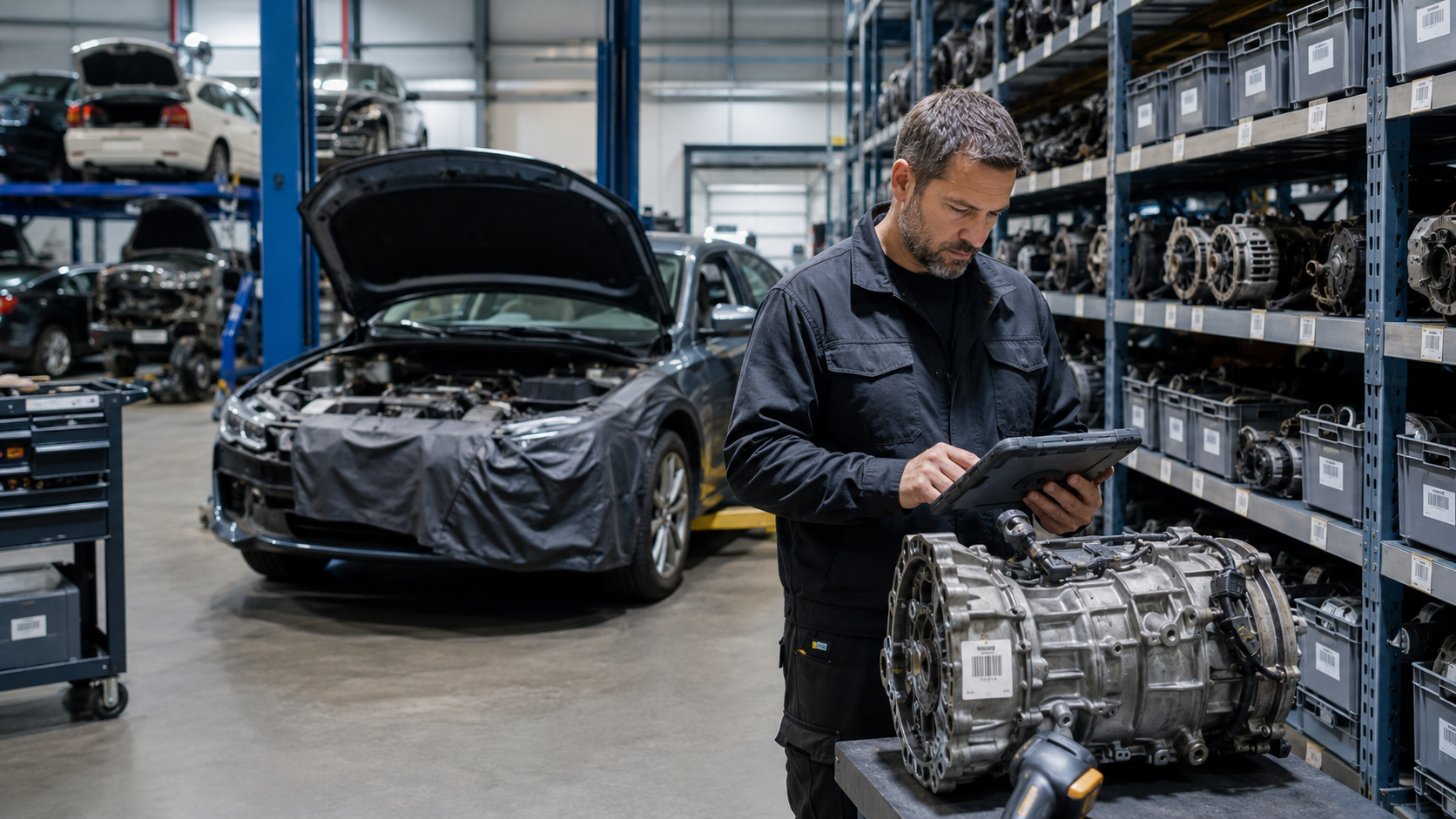
The image most people carry of an auto wrecker is outdated. Think rusted lots, parts pulled at random, no real inventory system. That business model still exists in pockets, but it’s not where the industry is heading.
Professional operators now run searchable, VIN-tagged digital inventories that let a mechanic or owner check part availability and compatibility before a vehicle even leaves the tow truck. They source from end-of-life vehicles processed under proper ELV compliance, which separates them from unregulated scrap operations that skip environmental handling requirements for fluids, batteries, and hazardous materials. They offer warranty cover on parts sold, and many ship nationally rather than serving a single postcode.
This is the tier of the supply chain that VIN-based matching depends on. It’s one thing to know a part will fit; it’s another to actually locate a specific one, verified and warranted, without weeks of phone calls to random yards. Operators like Tony’s Auto Wreckers represent this shift – inventory-driven businesses built around locating the right part for a specific VIN rather than hoping something close enough turns up. That’s the practical bridge between “recycled parts exist” and “a mechanic can actually get one sourced by tomorrow.” When a shop or owner is facing an eye-watering dealer quote, this is the kind of supplier worth calling before signing off on a brand-new OEM replacement.
The distinction matters because parts interchange data only has value if there’s a reliable inventory behind it. A cross-reference database tells you what should fit. A professionalised wrecker with proper stock control tells you what’s actually available, tested, and ready to ship.
Insurers are already moving this way
Insurance companies often realize that there is a significant difference in costs before customers do. Lately, the difference between the high-cost OEM-only parts quoted by manufacturers for repairs, and the less expensive guaranteed recycled alternative, has become remarkable.
Whether a car should be written off or repaired is being influenced by whether an equivalent used part can be quickly and cheaply found rather than a new OEM part being the default option on financial grounds.
There have always been “aftermarket parts” clauses in insurance policies but increasing reliability and warranty information on recycled and “alternative parts” is causing them to be referenced with higher frequency. It is procurement policy change by stealth. If a used VIN matched part is quicker and cheaper for the insurer to settle on and carries a warranty, then that is the default recommendation, not the fallback option.
Regulatory pressure is opening the door further
Right to Repair momentum isn’t limited to one region or one law. In Australia, the voluntary Motor Vehicle Service and Repair Information Sharing Scheme has pushed manufacturers to release repair and diagnostic data more broadly, while the ACCC has kept scrutiny on manufacturers that try to restrict access to parts and technical information. That combination has opened space for independent repairers and third-party parts suppliers to compete on service and price rather than just availability.
This regulatory environment is exactly where professional auto recyclers have room to grow. When independent shops have the diagnostic access to actually install a recycled part correctly, and when insurers are willing to approve it, the parts business quits being a two-tier system of “expensive dealer part” or “cheap aftermarket part.” It becomes a three-tier market, and the third tier – verified, VIN-matched recycled parts – increasingly wins on both cost and sustainability grounds.
What owners and mechanics should actually do
The message is clear for those who receive a repair estimate. Instead of opting for an expensive new OEM part, see if you can get a VIN-matched, warranted recycled alternative. Independent repair shops can now access the necessary data to check compatibility, and professional wrecking yards can search their inventory and determine if such a part is available in their yard.
Asking if a used part can be sourced in place of a new part accomplishes three things at once: it reduces the repair cost, it prolongs the life of the vehicle so it is not prematurely written off, and it saves the full carbon cost of manufacturing a new part, or in the worst case, an entirely new vehicle.
Right to Repair has created an opportunity and it is the smart parts locators and professional recyclers who are actually realizing its potential. With little fanfare, automotive waste reduction is benefiting more from these developments than from the majority of high-profile sustainability programs – it is simply becoming much cheaper and much greener.